
We’ve all seen it: the seemingly effortless splits of a gymnast, the deep backbends of a yogi, the fluid movements of a dancer. For most of us, this level of flexibility feels like a distant dream. Assisted stretching, where a trained professional helps you deepen stretches you couldn’t reach on your own, is a powerful way to bridge that gap. It can improve your range of motion, reduce muscle tension, and even boost athletic performance.
But just like any powerful tool, it comes with a manual – and ignoring it can lead to some serious pitfalls. It’s not just about a little discomfort; it’s about understanding the nuances that prevent injury and actually deliver the results you’re looking for. A little too much force or a slight misalignment can turn a beneficial session into a painful, counterproductive experience.
I’ve spent years in the world of fitness and movement, and I’ve seen the same recurring issues with assisted stretching. From eager clients to practitioners still learning the ropes, there are a handful of common mistakes in assisted stretching that crop up time and again. These errors can compromise your safety and stop you from reaping the full benefits of your session. So, if you’re looking to start assisted stretching or improve your current routine, let’s dig into the top five mistakes to avoid.
Mistake #1: Ignoring the Warm-Up
I’ll be honest, this is probably the most common mistake I see. You’ve booked a session, and you’re eager to get right into the deep work. But diving into intense stretches with cold muscles is like trying to bend a frozen garden hose—it’s stiff, resistant, and much more likely to crack.
Your muscles, tendons, and ligaments need to be warmed up and pliable before they can safely and effectively lengthen. A proper warm-up increases blood flow to the muscles, raising their temperature and making them more elastic (Behm & Chaouachi, 2011). This crucial step prepares your connective tissues for the demands of stretching. It’s non-negotiable for a safe and effective session.
A warm-up isn’t just about safety, though. When your muscles are warm, they respond better to stretching, allowing for a deeper and more lasting change in flexibility. So, when your practitioner suggests a few minutes of light cardio or dynamic movements, don’t skip it. It’s the most important part of the preparation.
What to do instead:
- Dynamic movements: Before your session, a few minutes of gentle cardio like walking or cycling, followed by dynamic stretches (e.g., leg swings, arm circles) can make a huge difference. Dynamic stretching involves moving a joint through its full range of motion, which helps prepare the muscles for activity.
- Communicate with your practitioner: If you haven’t had a chance to warm up, let your practitioner know. A good practitioner will always start with some gentle movements to get your body ready.
Mistake #2: The Silent Treatment: Not Communicating with Your Practitioner
Imagine a mechanic working on your car without you telling them where the noise is coming from. That’s what it’s like when you don’t communicate during an assisted stretch. The practitioner’s hands on you are like their eyes, but your words are their ears. They can feel tension, but they can’t feel pain.
There’s a subtle but critical difference between a deep stretch and pain. A good stretch should feel like a satisfying, gentle pull – a sensation of lengthening. Pain, on the other hand, is a signal from your nervous system that something is wrong. Pushing through it can lead to muscle tears or overstretching of ligaments, which can destabilize a joint (Ryan et al., 2019). The goal isn’t to push to the point of agony, but to gently and gradually increase your range of motion.
What to do instead:
- Be vocal: Use a rating system, such as a scale of 1 to 10, to communicate the intensity of the stretch. A good practitioner will ask for this feedback, but if they don’t, be proactive.
- Describe the sensation: Tell them if you feel a sharp pain, a tingling sensation, or a pinching feeling. These are important clues. The practitioner can then adjust the angle or intensity to ensure the stretch is both safe and effective.
- Breathe: Holding your breath is a common reaction to discomfort. It increases muscle tension and makes it harder to stretch. Instead, focus on slow, deep breaths. This helps relax your nervous system and allows your muscles to lengthen more easily.
Mistake #3: Improper Technique and Misalignment
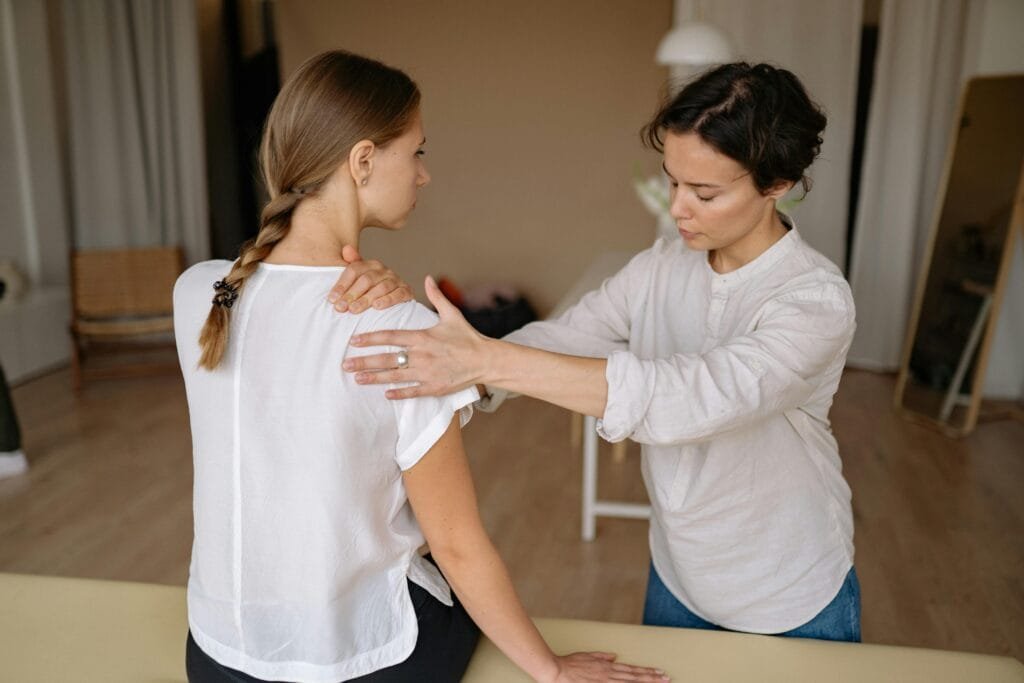
This is where the expertise of a trained professional truly shines. Without a trained eye, it’s easy to allow your body to compensate for a lack of flexibility, leading to improper technique and misalignment. I’ve seen clients tilt their pelvis, collapse their hips, or let their heads fall forward to “cheat” a stretch.
For example, when stretching the hamstrings, it’s crucial to maintain a neutral spine. If the hips are allowed to tilt backward, the stretch is no longer isolated to the hamstring but is absorbed by the lower back. This not only reduces the effectiveness of the stretch but can also put unnecessary strain on the lumbar spine. Similarly, during a pectoral stretch, letting the head or neck collapse can create tension rather than release it.
A skilled practitioner will ensure your body is properly aligned from head to toe, holding key points to support your posture and isolate the intended muscle group. They understand the intricacies of biomechanics and know how to position your body to get the most out of each movement while keeping you safe.
Key areas of alignment to watch for:
- Pelvic position: Are your hips level and stable?
- Spinal alignment: Is your back straight and neutral, or are you rounding?
- Joint placement: Are your shoulders, hips, and knees in a safe, aligned position?
If you are looking for a practitioner, make sure you do your homework. Services like those at StretchMasters® are a good example of places that use trained professionals who understand proper biomechanics.
Mistake #4: The Bouncing Act – Dynamic Stretching Gone Wrong
The idea of “bouncing” or ballistic stretching has been a contentious topic in the fitness world. Ballistic stretching involves a jerking or bouncing motion at the end of a stretch. While some forms of dynamic stretching are effective, bouncing into a deep, static stretch is a different story, and it’s a mistake that can lead to injury.
The problem with bouncing is that it triggers the “stretch reflex.” Your muscles have tiny sensory receptors that detect changes in muscle length and speed. When you bounce, these receptors fire, causing the muscle to involuntarily contract to protect itself from overstretching (Witvrouw et al., 2004). This is the exact opposite of what you want to achieve with stretching. Not only does it hinder your progress, but it can also increase your risk of muscle tears.
What to do instead:
- Embrace static stretching for deep work: A gentle, sustained stretch held for a specific period (usually 30–60 seconds) is the gold standard for increasing flexibility. This allows the stretch reflex to subside, enabling the muscle to lengthen effectively and safely (Page, 2012).
- Incorporate dynamic stretching correctly: If you want to use dynamic stretches, they should be performed smoothly and with control, not with a jarring bounce. They’re best used as part of a warm-up, not as the primary method for increasing flexibility.
Mistake #5: Pushing Through Pain and Ignoring Red Flags
We’ve touched on the difference between discomfort and pain, but it’s worth revisiting in more detail. The line between a challenging stretch and an injurious one can be very fine. The biggest red flag is pain. If something feels sharp, sudden, or localised to a joint, it’s a sign to stop immediately.
I often see clients who are so determined to “fix” an issue that they push through pain, especially if they are stretching an old injury. Assisted stretching is an excellent tool, but it’s not a substitute for medical advice. If you have an injury, or a condition like a herniated disc, osteoporosis, or a recent sprain, stretching in certain ways could worsen the problem. For instance, attempting to stretch a hamstring with an existing tear could lead to further damage (Witvrouw et al., 2004).
Similarly, if you have muscle imbalances – where one muscle group is significantly tighter or weaker than its opposing group – it’s crucial to address both. Stretching one side without strengthening the other can exacerbate the imbalance and lead to instability. A good practitioner can help identify and address these issues, but you must be honest with them about your medical history.
What to do instead:
- Be transparent about injuries: Before your session, provide a full medical history to your practitioner, including any past or current injuries, surgeries, or medical conditions. A reputable service, such as those you can find on the StretchMasters® blog, will always have a consultation process to gather this information.
- Listen to your body: It’s your most reliable source of feedback. If a stretch feels “wrong,” it probably is. Don’t be afraid to say “no” or “stop.” Your practitioner’s job is to listen and adapt.
- Seek medical advice: If you have a significant injury, consult with a physiotherapist or other healthcare professional before starting an assisted stretching programme.
Table: Static vs. Dynamic Assisted Stretching
To clarify the difference between the two main types of stretching, here is a helpful table.
| Characteristic | Static Assisted Stretching | Dynamic Assisted Stretching |
| Movement Style | Slow, sustained hold at the end of the range of motion. | Controlled movement through the full range of motion. |
| Duration | Typically held for 30-60 seconds. | Performed in reps and sets, e.g., 10-15 reps. |
| Purpose | To increase long-term flexibility and range of motion. | To warm up muscles and prepare the body for activity. |
| Best Used | For a deep stretch after a warm-up or workout. | As a warm-up before exercise or sports. |
| Safety | Very low risk of injury when done correctly. | Low risk of injury, but requires control to avoid ballistic movements. |
Final Thoughts
Assisted stretching is a powerful and effective way to improve your flexibility, reduce muscle tension, and feel better in your own skin. But like anything, the devil is in the details. By avoiding these common stretching errors – ignoring the warm-up, staying silent, allowing for improper technique, bouncing, and pushing through pain – you can ensure your sessions are not only safe but also truly beneficial.
So, the next time you step onto the mat, go in with a clear mind and an open line of communication. Your body will thank you for it.
Ready to start your journey to a more flexible you? Learn more about the benefits of assisted stretching and find a practitioner near you on the StretchMasters® website. And for more tips and insights, be sure to check out our other articles on the Stretchmasters blog, like “How to Combine Assisted Stretching with Strength Training” and “The Ultimate Checklist for Effective Assisted Stretching Sessions”.
References
- Behm, D. G., & Chaouachi, A. (2011). A review of the acute effects of static and dynamic stretching on performance. European Journal of Applied Physiology, 111(11), 2633-2651. https://doi.org/10.1007/s00421-011-1879-2
- Furlan, M., Tiso, I., Bovo, S., & Boffa, V. (2012). Combined therapeutic exercise and stretching for the management of forward head posture and neck pain: A case report. International Journal of Therapy and Rehabilitation, 19(5), 269–275.
- Page, P. (2012). Current concepts in muscle stretching for exercise and rehabilitation. International Journal of Sports Physical Therapy, 7(2), 109–119.
- Ryan, E. D., Herda, T. J., Costa, P. B., Walter, A. A., Hoge, K. M., & Cramer, J. T. (2019). The effects of static and ballistic stretching on muscle activation and force production. Journal of Strength and Conditioning Research, 33(4), 947-955. https://doi.org/10.1519/JSC.0000000000002934
- Witvrouw, E., Mahieu, N., Danneels, L., & Cambier, P. (2004). Stretching and injury prevention: An update. Sports Medicine, 34(7), 437–446. https://doi.org/10.2165/00007256-200434070-00003
Disclaimer:
The content on this blog is provided for general information and wellness purposes only. It should not be considered medical advice, diagnosis, or treatment. StretchMasters® services, including assisted stretching, are intended to support overall wellbeing and are not a substitute for professional healthcare guidance. While reasonable care has been taken in preparing and verifying the information presented in this blog, StretchMasters® makes no claims, representations, or guarantees regarding its completeness, accuracy, reliability, suitability or availability with respect to the website or the information, products, services, or related graphics contained on the website for any purpose. This content is intended for general informational purposes only and is not a scientific article. Inconsistencies, inaccuracies, or errors — including in paraphrasing and citation — may be present. Any reliance you place on such information is therefore strictly at your own risk. We strive to ensure that all information is accurate and up to date; however, due to the evolving nature of health research, we cannot guarantee that all content reflects the latest evidence. Additionally, external links shared in blog posts may change, be updated, or become inactive over time without notice. Always consult with a qualified medical professional before starting any new therapy, especially if you have existing health conditions. StretchMasters®, its parent company Skuil Ltd, and affiliated clinics accept no liability for decisions made or outcomes based on this content. Opinions expressed in individual blog posts are those of the authors and do not necessarily reflect the views or policies of StretchMasters® or its subsidiaries. Any reference to third-party organisations, websites, services, or products is not an endorsement.