Unlock better mobility, reduce stiffness, and boost independence with PNF-based assisted stretching for seniors. Discover safe, professional techniques and evidence-based benefits for older adults.
Introduction: The Strategic Investment in Mobility
The journey of aging often involves a gradual decline in the ease of daily movement. For many, the focus shifts from physical performance to the simple, critical task of bending down to tie a shoelace without a groan. This natural decline in flexibility and Range of Motion (ROM) is a common, often frustrating, part of aging.
Ageing doesn’t necessarily mean giving up on movement; it means getting smarter about it. This is where assisted stretching for seniors – our core keyword – steps into the spotlight. It’s not a luxury; it’s a strategic, evidence-based investment in your mobility, independence, and overall quality of life.
Assisted stretching provides outsourced maintenance for your most critical machine: your body. We will dive deep into this refined practice, why it’s particularly effective for older adults, and how a professional approach offers tangible, evidence-based benefits.
What is Assisted Stretching and Its Specialized Mechanism
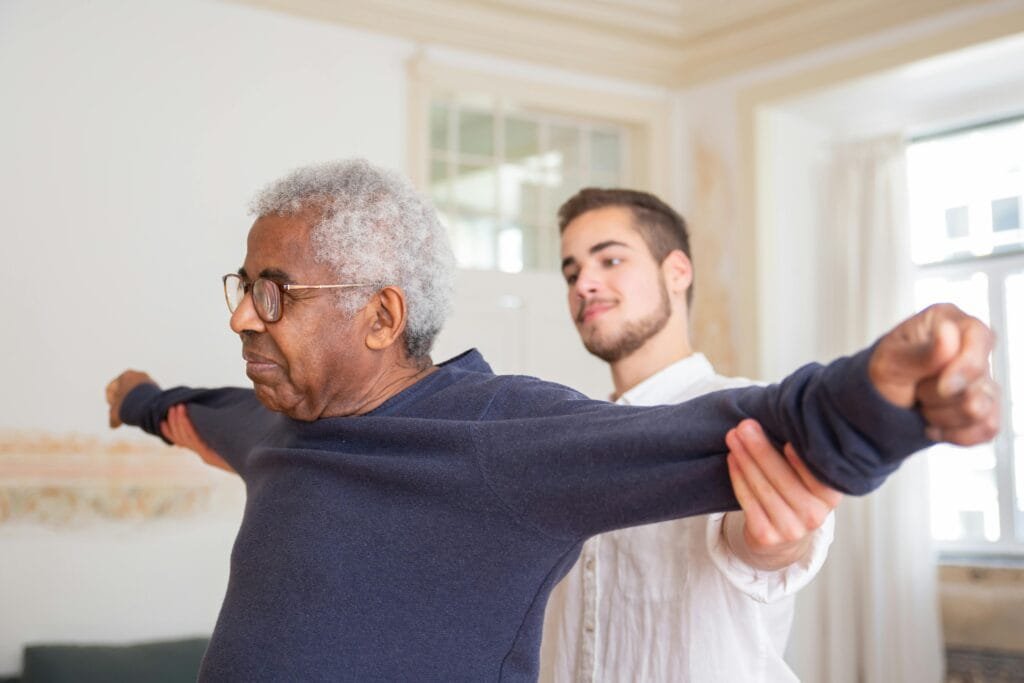
Assisted stretching is a form of passive stretching where an external force – typically a trained professional like a stretch therapist or physiotherapist- moves a joint or limb into a stretch. This approach provides a profound functional advantage for older adults, as the professional can guide the body far deeper and more precisely than they often can safely manage alone.
A key technique used in professional assisted stretching is Proprioceptive Neuromuscular Facilitation (PNF).
The Mechanism: Autogenic Inhibition and the Golgi Tendon Organ
PNF is a sophisticated technique, often using a ‘contract-relax’ sequence to achieve greater acute gains in ROM. The steps are:
- The muscle is gently stretched to its end-range by the partner (assisted passive stretch).
- The individual briefly contracts the stretched muscle against the partner’s resistance (an isometric hold).
- The individual relaxes, and the partner immediately stretches the muscle further.
This sequence is hypothesised to use the body’s own neural machinery, specifically the Golgi Tendon Organ (GTO), to momentarily “trick” the muscle into relaxing beyond its normal tension limit. This physiological process is known as Autogenic Inhibition, which leads to greater, more reliable, and faster acute ROM gains compared to simple static stretching.
Evidence-Based Benefits for Functional Outcomes
| Benefit Category | Specific Advantage for Older Adults | Supporting Mechanism/Evidence |
| Functional Independence | Direct improvement in the ability to perform Activities of Daily Living (ADLs), such as getting out of a chair or reaching overhead. | Studies on active-assisted stretching programs in the elderly have demonstrated significant increases in functional performance measures (e.g., Chair Stand Test). |
| Mobility & Flexibility | Increased overall Range of Motion (ROM) and improved spinal flexibility, crucial for daily tasks like looking over the shoulder. | Chronic stretching can reduce the intrinsic stiffness of the muscle-tendon unit and produce neural adaptations. |
| Pain & Stiffness | Relief from generalised muscle stiffness and common age-related aches, particularly Chronic Lower Back Pain (LBP). | Regular stretching reduces stiffness and pain in muscles and joints, especially when targeting key areas like the hamstrings and hip flexors. |
| Posture & Balance | Improved body alignment and stability by addressing muscular imbalances in the hips and trunk. | Increased hip and ankle flexibility directly contributes to improved static and dynamic balance, a key prerequisite for fall prevention. |
| Joint Health | Improved health and lubrication for critical joints like hips and knees. | Enhanced ROM promotes joint health by encouraging the movement of synovial fluid, which nourishes joint cartilage and can reduce joint contractures. |
The Critical Questions: Safety, Pain Relief, and Professionalism
When considering assisted stretching for seniors, questions about safety and real-world efficacy rightly take precedence. The safety of this intervention is entirely dependent on the expertise and restraint of the professional administering the stretch.
Is Assisted Stretching Safe for Seniors with Joint Concerns?
A trained professionallike a physiotherapist has a deep understanding of anatomy, biomechanics and musculoskeletal pathology, which is vital for safe practice.
- Osteoarthritis (OA): Stretching is a recommended part of a multi-component regimen for OA to improve ROM and alleviate pain. However, a professional knows to apply safe, gentle, and controlled movements to avoid exacerbating symptoms, as aggressive stretching on a joint with acute swelling can cause pain and injury.
- Joint Replacements (Arthroplasty): Following hip or knee replacement surgery, strict precautions regarding movement limits are in place for months. Assisted stretching for post-injury seniors must be cleared by a surgeon or physiotherapist. The professional’s role is to work safely within the established, permissible range to facilitate recovery.
Bottom Line: Never use an uncertified, untrained person for stretching in these scenarios. A high-quality provider will adhere to professional standards, ensuring safety is paramount.
Can Assisted Stretching Help Relieve Lower Back Pain?
Chronic LBP often involves muscle weakness, stiffness, and poor posture. Flexibility training is a cornerstone of LBP management, especially when targeting the hip flexors and hamstrings.
- Tight hamstrings and hip flexors can tilt the pelvis, increasing the arch in the lower back (lumbar lordosis), which contributes to pain.
- Assisted stretching allows for a deeper, more controlled stretch on these posterior chain muscles than many seniors can achieve independently.
- This makes it a valuable non-pharmacological tool for reducing stiffness and improving mobility in the lumbar spine.
The Strategic Advantage: Assisted vs. Self-Stretching Alone
| Feature | Self-Stretching (Static) | Assisted Stretching (PNF/Passive) |
| Depth of Stretch | Limited by one’s own muscular strength and pain tolerance. | Maximised by external, controlled force; often reaches a greater, safer end-range. |
| Safety & Control | Risk of injury due to poor form, over-stretching, or loss of balance. | High control; professional adjusts intensity based on real-time feedback; minimises injury risk. |
| Efficacy for ROM | Effective, but results are often slower and less pronounced in the short term. | Utilises PNF for potentially greater, faster acute ROM gains. |
| Accessibility | Challenging for those with assisted stretching for seniors with limited mobility or high stiffness. | Accessible to all, including those seated or with significant mobility restrictions. |
The primary advantage of partner-assisted stretching for seniors lies in the magnitude and consistency of the stretch applied. A professional ensures correct body alignment, prevents compensation and potential injury, and provides targeted depth on hard-to-reach or critical muscles like the hip flexors and quadriceps.
Functionality and Fall Prevention
The ultimate goal of improving flexibility is improved functionality. This directly aligns with critical health outcomes like fall prevention.
Assisted Stretching as an Essential Pre-Cursor to Fall Prevention
Falls are a leading cause of injury-related mortality and serious disability among older adults. While stretching alone is not a standalone fall prevention strategy, its role is foundational.
- The Problem: Strength is only useful if it can be deployed through a full, functional ROM.
- The Solution: Stretching reduces muscle stiffness and increases flexibility, especially in the hips and ankles. Better hip and ankle flexibility directly contributes to improved static and dynamic balance.
- The Context: Effective fall prevention strategies must focus on strengthening leg and ankle muscles and challenging balance. The most effective programs are multi-component, integrating strength, balance, and flexibility.
Assisted stretching acts as a powerful accelerant for the flexibility component, ensuring the body has the range to execute the critical strength and balance drills that do prevent falls.
Frequency and Practicalities
Determining the ideal frequency depends on individual goals, but scientific consensus suggests:
- Minimum Threshold: For general health, static stretching should be performed at least twice a week.
- Optimal Frequency: Protocols that included 3-6 sessions per week over eight weeks have shown optimal results in older adults.
- The Assisted Advantage: One or two professional assisted stretching sessions per week, supplemented by gentle self-stretching at home, can be a highly effective and sustainable approach.
For your session, wear comfortable, loose-fitting or stretchy athletic wear that allows for a full range of motion. A professional will conduct an initial assessment of your medical history and mobility goals, ensuring safety and efficacy.
Crucial Safety Note on Pain: You must feel tension, a “good stretch,” but never sharp, searing, or intolerable pain. You are the final authority on the depth of the stretch. Always inform the therapist immediately of any joint replacements, acute pain, recent injury, or if you are taking blood-thinning medication.
Conclusion: Investing in Your Mobile Future
The evidence is clear: dedicating time and professional resources to your flexibility is one of the most proactive and beneficial investments you can make in your longevity and quality of life. Assisted stretching for seniors provides a scientifically supported pathway to unlock greater mobility, reduce stiffness, and enhance the functional capacity that underpins independence.
By working with a trained professional, you gain a tailored, safe, and effective routine designed to address the specific changes of your aging body. It’s time to negotiate a better deal with your body – one that includes a future where you can move with the ease and confidence you deserve.
Ready to start moving better, feeling looser, and embracing a more mobile lifestyle?
- Discover more about the techniques mentioned in this article, like the differences between passive and active stretching, on our blog.
- Explore our dedicated services and learn how a tailored senior assisted stretching and exercises program can be integrated into your weekly routine by visiting StretchMasters®.
Discover other related articles:
- The Ultimate Guide to Assisted Stretching for Beginners
- How to Create a Relaxing Environment for Assisted Stretching
- The Top 5 Assisted Stretching Mistakes to Avoid
- How to Use Assisted Stretching to Prepare for a Marathon
- How to Improve Flexibility and Mobility for a Healthier Lifestyle
References
- UK Health Security Agency. Blog – A new focus on falls prevention. Kevin Fenton, 25 January 2017 – Health and Wellbeing.https://ukhsa.blog.gov.uk/2017/01/25/a-new-focus-on-falls-prevention/
- Mechanism-Driven Strategies for Reducing Fall Risk in the Elderly: A Multidisciplinary Review of Exercise Interventions by Yuan-Ji Zhong, Qing Meng, and Chun-Hsien Su. https://www.mdpi.com/2227-9032/12/23/2394
- Damian C. Stanziano et al., “The Effects of an Active-Assisted Stretching Program on Functional Performance in Elderly Persons: A Pilot Study,” Clinical Interventions in Aging 4 (2009): 115. https://pubmed.ncbi.nlm.nih.gov/19503774/
- Johns Hopkins Arthritis Center. (n.d.). Rehabilitation management for rheumatoid arthritis patients. Retrieved [May, 25th, 2025], from https://www.hopkinsarthritis.org/patient-corner/disease-management/rehabilitation-management-rheumatoid-arthritis-patients/
- StretchMasters Stretch Clinic. (n.d.). Assisted Stretching For Fitness Performance. Retrieved May 25, 2025, from https://stretchmasters.co.uk/assisted-stretching-for-fitness-performance/
- StretchMasters Stretch Clinic. (n.d.). Assisted Stretch Therapy for Active Seniors: Your Guide to Staying Limber, Independent, and Ready for Anything. https://helpmestretch.co.uk/assisted-stretch-therapy-active-seniors/
- Nelson, A. G., Kokkonen, J., Arnall, D. A., & Li, L. (2012). Acute stretching increases postural stability in nonbalance trained individuals. Journal of Strength and Conditioning Research, 26(11), 3095–3100. https://doi.org/10.1519/JSC.0b013e3182430185
- Tufts School of Medicine. (2023, May 23). Exercise Can Help Decrease Fall Risk for Elderly People. https://medicine.tufts.edu/news-events/news/exercise-can-help-decrease-fall-risk-elderly-people
- Caplan, N., Rogers, R., Parr, M. K., & Hayes, P. R. (2009). The effect of proprioceptive neuromuscular facilitation and static stretch training on running mechanics. Journal of Strength and Conditioning Research, 23(4), 1175–1180. https://doi.org/10.1519/JSC.0b013e318199d6f6
- Hatefi, M., Babakhani, F., & Ashrafizadeh, M. (2021). The effect of static stretching exercises on hip range of motion, pain, and disability in patients with non-specific low back pain. Journal of Experimental Orthopaedics, 8(1), 109. https://doi.org/10.1186/s40634-021-00371-w
- Marcucci, L., & Reggiani, C. (2020). Increase of resting muscle stiffness, a less considered component of age-related skeletal muscle impairment. European Journal of Translational Myology, 30(1), 8982. https://doi.org/10.4081/ejtm.2019.8982
- Wilkinson, D. J., Piasecki, M., & Atherton, P. J. (2018). The age-related loss of skeletal muscle mass and function: Measurement and physiology of muscle fibre atrophy and muscle fibre loss in humans. Ageing Research Reviews, 47, 123–132. https://doi.org/10.1016/j.arr.2018.07.005
Disclaimer:
The content on this blog is provided for general information and wellness purposes only. It should not be considered medical advice, diagnosis, or treatment. StretchMasters® services, including assisted stretching, are intended to support overall wellbeing and are not a substitute for professional healthcare guidance. While reasonable care has been taken in preparing and verifying the information presented in this blog, StretchMasters® makes no claims, representations, or guarantees regarding its completeness, accuracy, reliability, suitability or availability with respect to the website or the information, products, services, or related graphics contained on the website for any purpose. This content is intended for general informational purposes only and is not a scientific article. Inconsistencies, inaccuracies, or errors – including in paraphrasing and citation – may be present. Any reliance you place on such information is therefore strictly at your own risk. We strive to ensure that all information is accurate and up to date; however, due to the evolving nature of health research, we cannot guarantee that all content reflects the latest evidence. Additionally, external links shared in blog posts may change, be updated, or become inactive over time without notice. Always consult with a qualified medical professional before starting any new therapy, especially if you have existing health conditions. StretchMasters®, its parent company Skuil Ltd, and affiliated clinics accept no liability for decisions made or outcomes based on this content. Opinions expressed in individual blog posts are those of the authors and do not necessarily reflect the views or policies of StretchMasters® or its subsidiaries. Any reference to third-party organisations, websites, services, or products is not an endorsement.